Allocations and the capital account
The allocation run is where fund-level results become investor-level results. Everything the period produced - portfolio gains, income, expenses, fee accruals - is partitioned across the capital accounts that were present to earn it, and the run is the only writer of that partition. Nobody hand-allocates.
What a run does
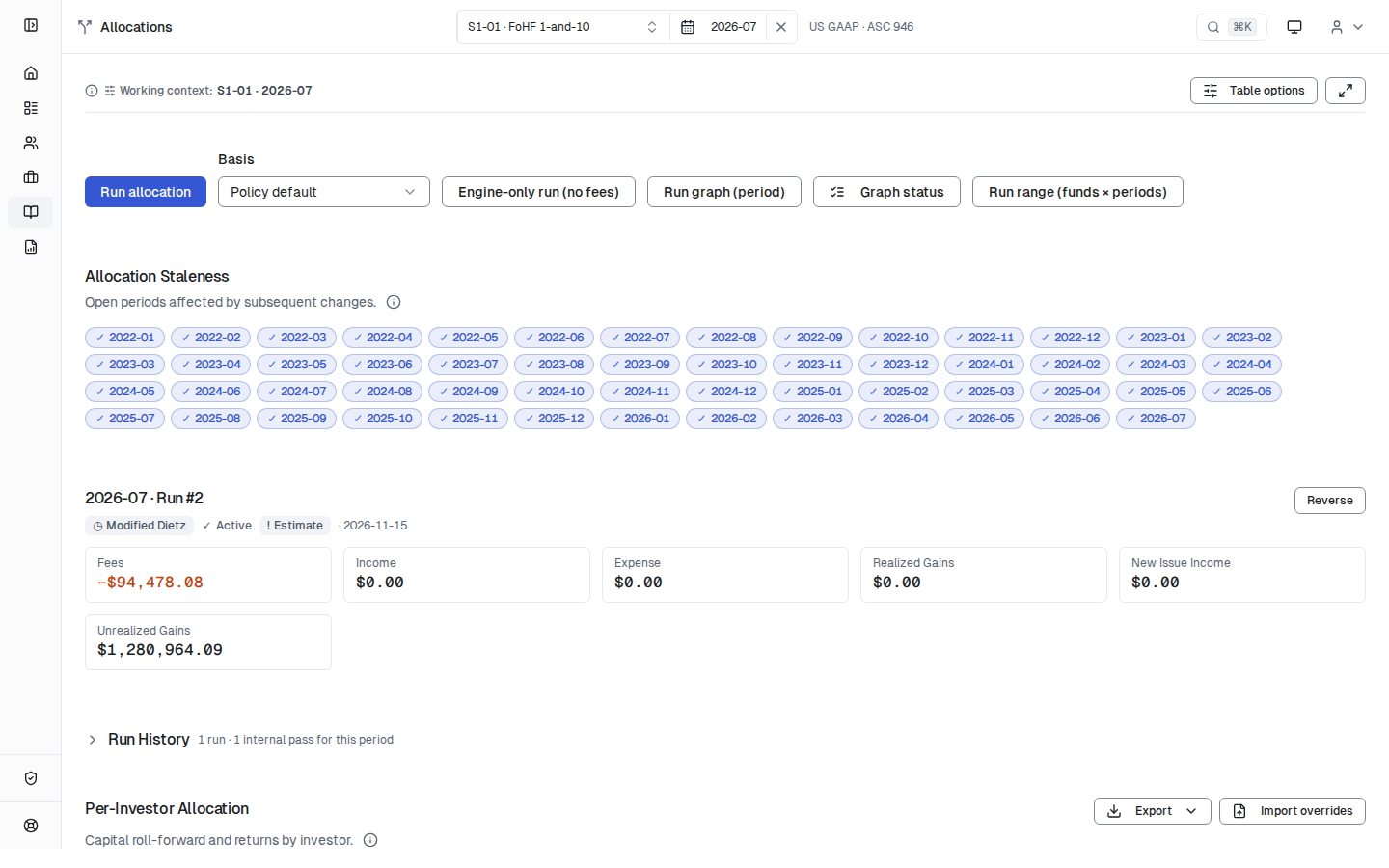
Allocations executes the period's sequence: establish each account's opening capital and ownership, apportion each P&L component by the method the fund's configuration selects, apply fees in their place in the ordering, and land the result on the capital account. Runs are repeatable: re-running a period replaces its allocation rather than stacking a second one, and late-arriving activity in an open period ripples forward with guards that surface, rather than silently absorb, a change to already- reported numbers.
Capital-based and unitized
A capital-based fund allocates by each account's share of capital over the period, respecting intra-period flows. A unitized fund reaches the same economics through units and NAV per unit. The method is fund configuration, not operator choice at run time, and the accounting checks that reconcile fund P&L to the sum of investor allocations hold identically for both.
Equalization and series
Funds that admit investors at different points face the classic fairness problem: the incentive fee a mid-year subscriber owes is not the incentive fee a January subscriber owes. The Equalization tab of Fees records the per-investor corrections for equalization-method funds, and series accounting solves the same problem structurally - each subscription cohort is its own series with its own basis and high-water mark, accruing its own incentive until consolidation.
Losses and their memory
The Loss carryforwards tab of Fees is the fund's memory of allocated losses where the fee terms say losses must be recovered before incentive accrues again. Carryforwards are consumed by subsequent gains in order and can expire by their terms; the tab shows each account's balance and its consumption history, which is the audit trail an investor asks for when their incentive resumes.
Crystallization
An accrued incentive fee becomes a charge at a crystallization event - scheduled (year end), or triggered (redemption, transfer). The Crystallizations tab of Fees lists every event with its computed amount against the account's high-water mark. A pending event is a period that is not finished: the close guards will refuse to seal a period that still has one.