Fees: from structure to charge
A fee in 1494 Labs is a pipeline, and each stage has its own screen. Nothing charges an investor until every stage upstream of the charge exists.
1. Structure
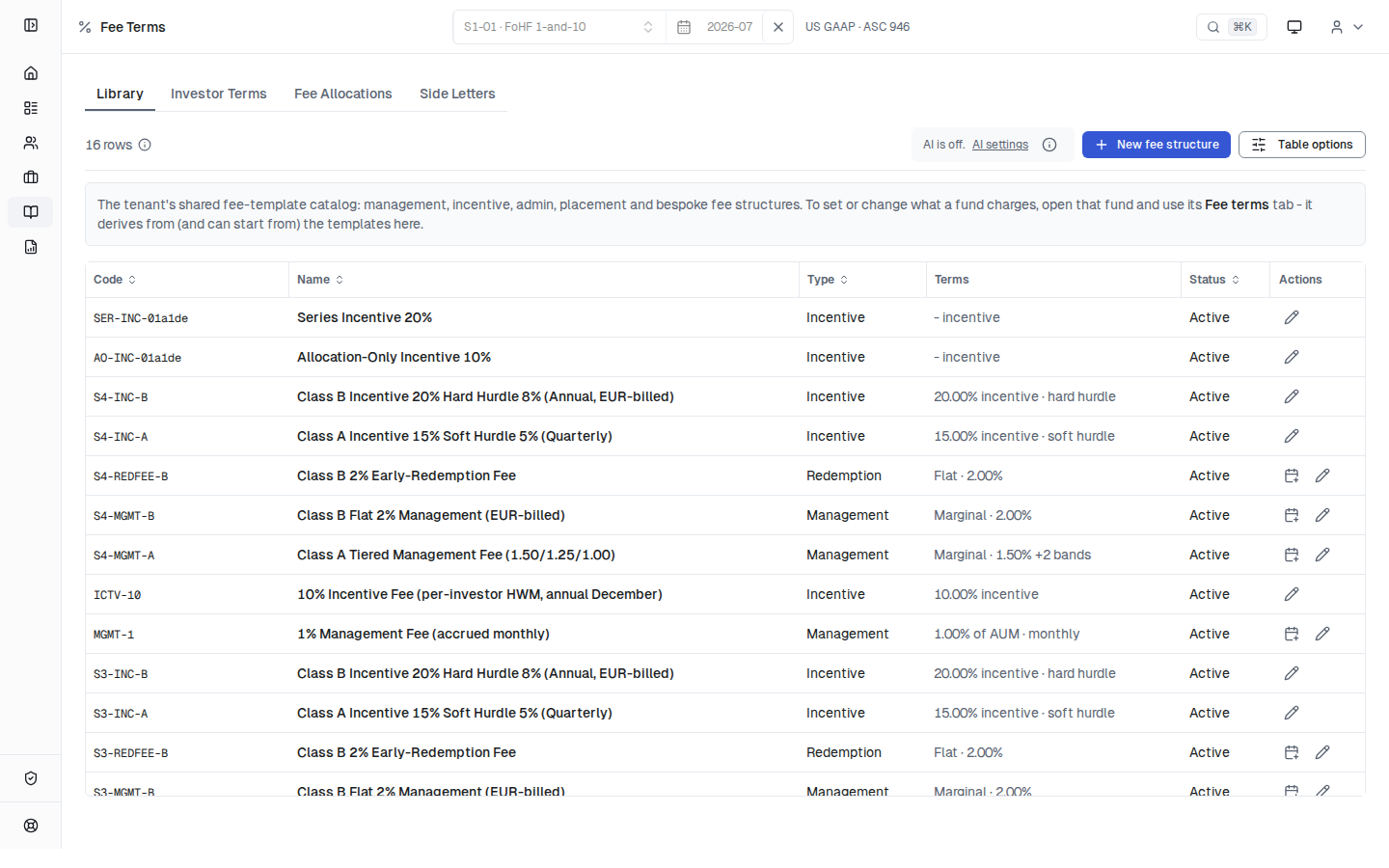
A Fee Structure is the term sheet: a management fee's rate, basis and frequency, or an incentive fee's rate, hurdle, high-water-mark behavior and crystallization terms. Structures are reusable definitions; creating one charges nobody. Day to day, author a fund's terms on that fund's Fee terms tab (fund hub) rather than here - it derives the structures, classes and assignments below this chapter's pipeline for you, in LPA language. The Library tab of Fee terms is the demoted catalog: the tenant's shared templates, and a read-only "derived from" view of every structure a fund's terms sheet produced.
Include current-period P&L in fee base is separate from the NAV point. Excluded (the default) preserves the capital anchor and prior-period P&L. Included adds the current period's non-fee P&L before management and incentive fees. The NAV point still chooses opening, closing or average; average uses opening and gross closing NAV, rather than becoming a closing-only base. Change an in-use term through a new version effective from a period start.
For non-series funds, a posted included-income management fee participates in full/percentage exit re-resolution. On a day-one full exit, cash retained only to pay that fee has no subsequent investment P&L weight. Ordinary excluded-income fees do not acquire that treatment, including when fee review was switched off after a proposal was saved. Re-entry and capital above the fee bound remain invested.
This exit convergence does not run for SERIES funds: their existing cohort workflow remains in force, so do not treat this option as automatic series full-exit settlement. With fee review enabled, a held fee gives no reserve; approve the proposal and rerun before settling an exit. A changed split can require a fresh approval. Check the final posted fee and redemption before settlement; an unapproved fee is not a settled charge.
2. Assignment
An Assignment binds a structure to a specific investor account from an effective period, optionally to an expiration period. Assignments are where side-letter reality lives: two investors in the same class can carry different terms. An investor who fully redeems should have their assignments expired in the following period. The Investor terms tab of Fee terms is the read-mostly ledger; add an investor-specific term from the fund's Fee terms tab instead, and it writes these rows for you.
3. Accrual
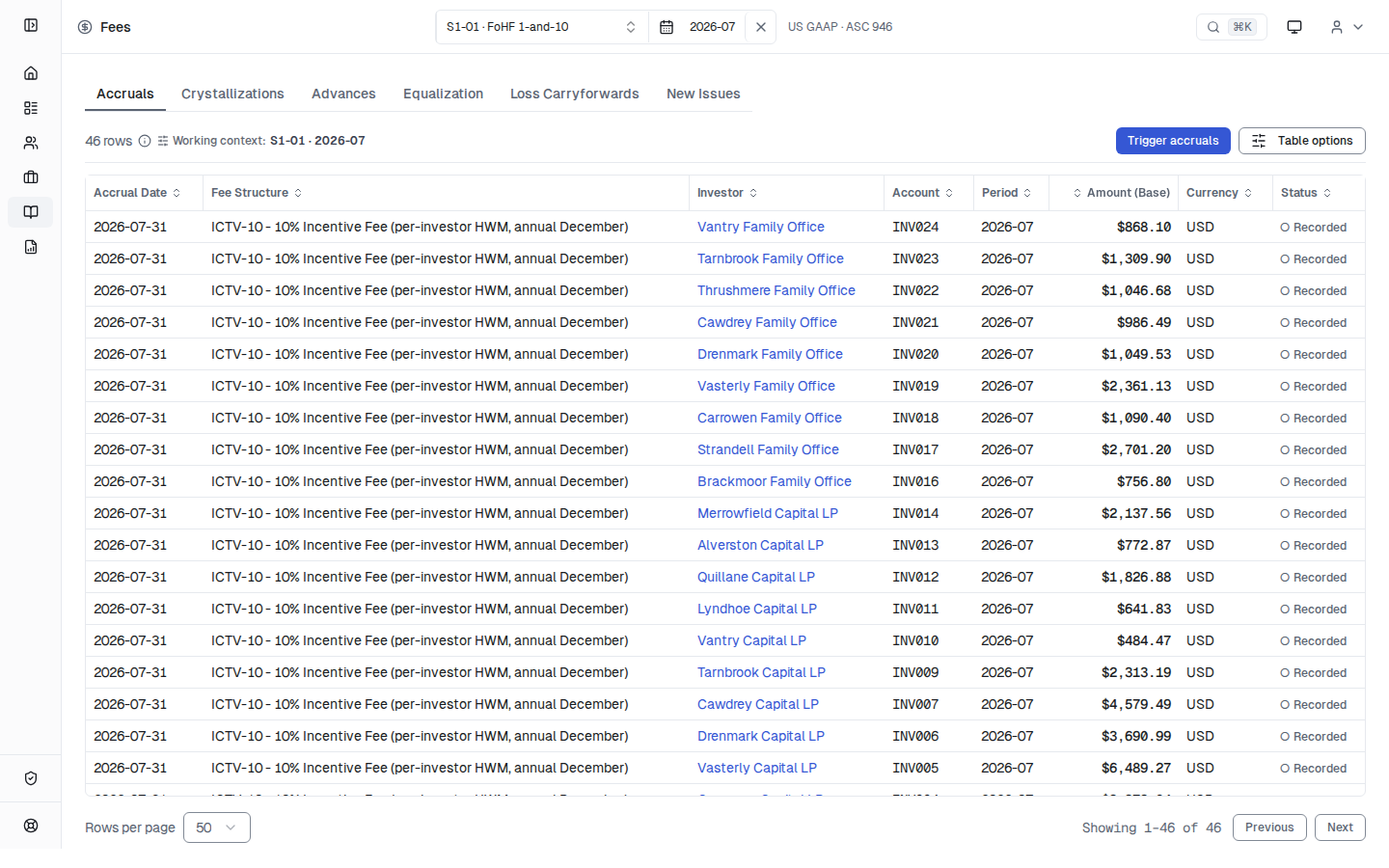
Fees is the one screen for what the engine has charged, a tab per ledger: accruals, crystallizations, equalization and loss carryforwards. Its Accruals tab shows the charges as they build. Management fees accrue each period on their basis inside the allocation run. Incentive fees accrue against each account's own high-water mark (a fund running series accounting accrues per series cohort instead, each cohort against its own mark). An accrued-and-netted fee reduces the investor's capital the moment it posts, and a matching entry carries the balance-sheet liability until settlement.
4. Crystallization
The Crystallizations tab of Fees is the incentive fee's event log: the moment a provisional accrual becomes the manager's money. Two regimes exist:
- Final (the default): crystallization happens on the schedule (annually, or at a redemption for the departing portion) and is irreversible once posted. The account's high-water mark steps at the same moment.
- Advance: the fund pays interim advances each quarter against the year's entitlement, measured cumulatively against a basis frozen at the reference period's start. At year end a true-up reconciles: an under-advanced account crystallizes the shortfall, an over-advanced one gives back through the fund-level clawback, and only the true-up steps the high-water mark. Advances never do.
Every posted event links to the accruals it crystallized, in what proportion, and every reversal is an audit-logged anti-event. The accounting-check sweep certifies the arithmetic nightly: totals tie to linked accruals, high-water marks step only where the regime says they step, and clawback balances tie to the ledger.
The second fee layer
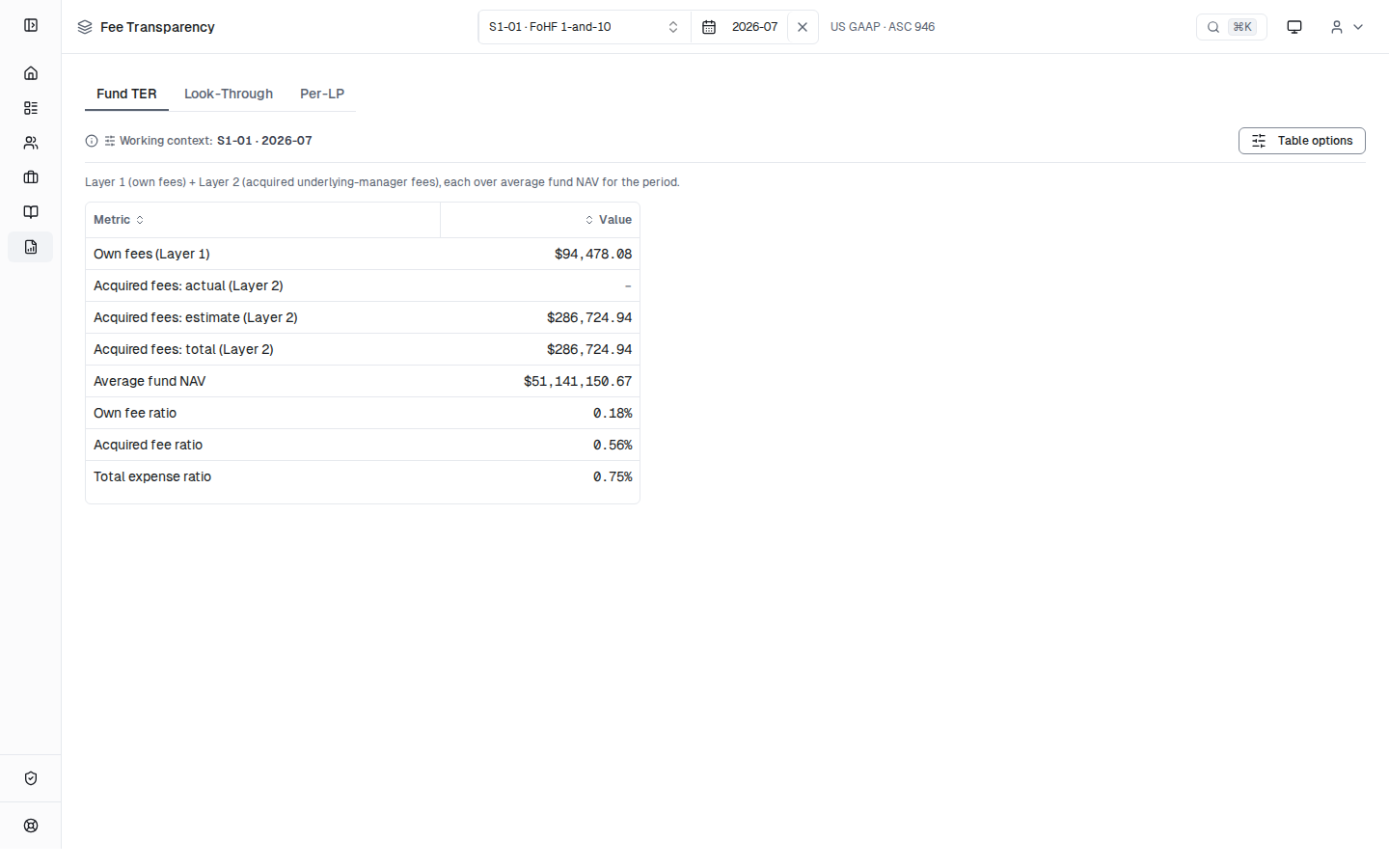
A fund of funds also bears the fees inside the NAVs it holds. Fee Transparency captures those acquired fees as disclosures: they enter reporting (total expense ratio, look-through) and deliberately never enter the ledger, because the manager's NAV already nets them and booking them again would double-count.