The investor lifecycle
An investor's relationship with a fund is a sequence of capital events, and every one of them is a ledger fact: subscriptions, redemptions, transfers, and eventually the capital account that summarizes them. Nothing in this platform tracks an investor position outside the books.
Identity and the capital account
Investors hold identity - who the LP is, their KYC state, their contacts. The money lives in the capital account, which the platform provisions automatically the first time an investor transacts with a fund: you never create one by hand, and Capital Accounts is where you read it - contributions, withdrawals, allocated P&L, fees, and the resulting balance, period by period.
Subscriptions and redemptions
Subscriptions & Redemptions lists direct capital entries and offers New Subscription, New Redemption and Other activity actions. Capital calls are entered under Commitments & Calls; distributions have their own screen. An investor who is not on file yet can be created from the subscription form itself, entity and investor together, without leaving it.
Capital activity walks create, confirm, post. Posting journalizes: a subscription books a receivable against contributed capital, and cash arrives separately. On the subscription itself, or in the list's Received column, choose Record cash received, enter the received date and amount (in the fund's base currency). The amount defaults to what is outstanding. You need cash write permission.
Before the dealing date, a receipt books cash against subscriptions received in advance. Confirming and posting releases that cash to operating cash and clears the advance liability. A short advance leaves the difference as a receivable. On or after dealing, post the subscription first; recording cash then clears its receivable, including partial receipts. The subscription shows Awaiting cash, Received in advance, Received, or Short, the received date, and the outstanding amount. An excess is shown explicitly and must be resolved before recording; it is never silently netted. To correct a short advance before posting, reverse it and enter the correct receipt.
Use Reverse receipt beside a receipt on the subscription to undo it. Enter a reason and unwind any bank reconciliation or receipt application first. The accounting period must still be open. Reversal preserves the audit trail and reopens the subscription's outstanding balance, even after issuance.
Posted redemptions offer Record cash paid on their own cash movement too; a partial payment leaves the remainder payable.
Redemptions reverse the flow and carry the extra weight: a full redemption crystallizes the account's incentive fee against its high-water mark, and holdback terms retain a sliver until the final NAV is struck.
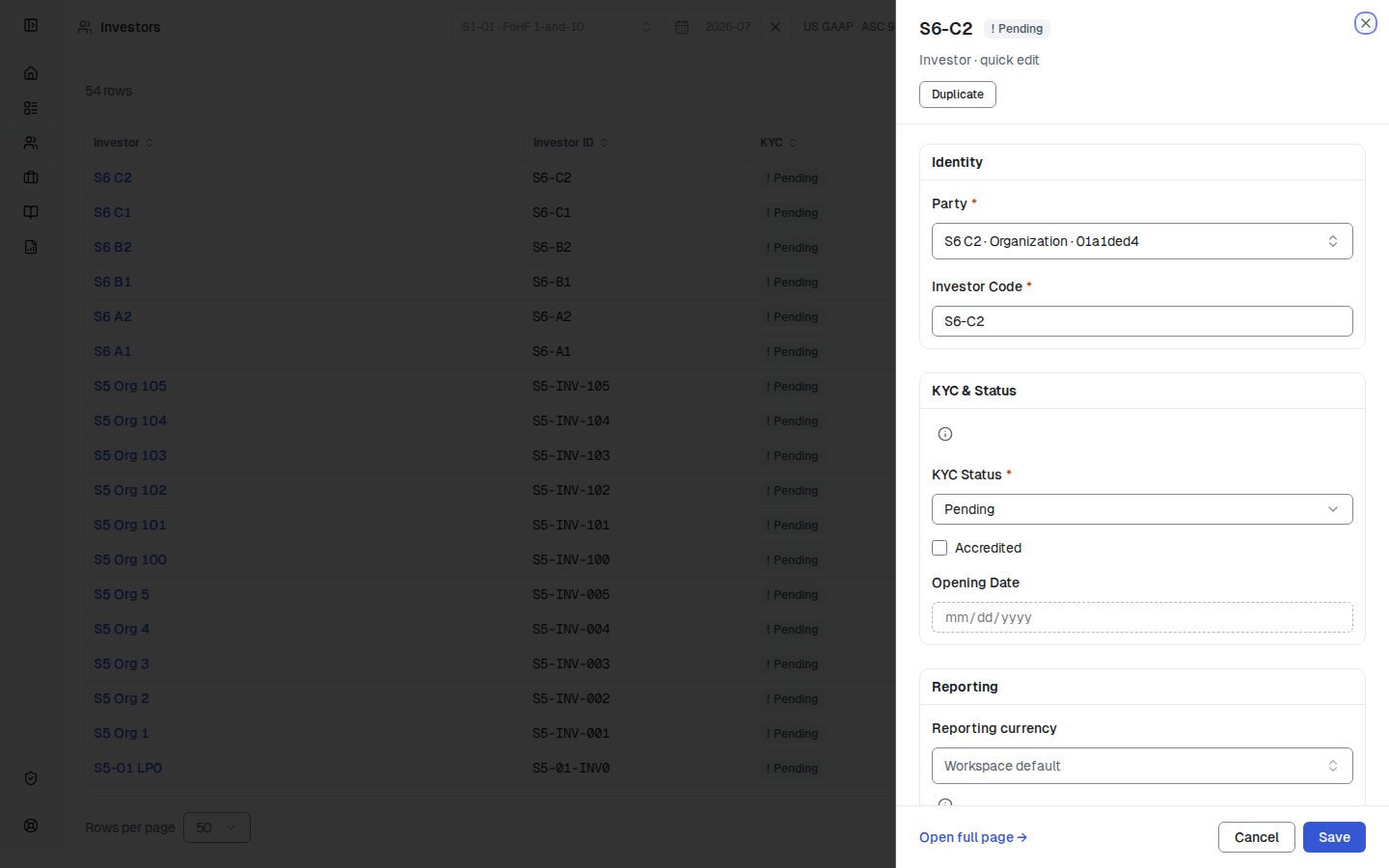
While the period is open, activity is editable and even deletable - the posting unwinds cleanly and downstream allocations are guarded against silent divergence. Once the period closes, the record is sealed; a correction becomes a new event in the current period, linked back.
Transfers
Investor Transfers moves an interest between investors without passing through the market: full or partial, and either net or gross of accrued incentive. The economic switch is whether the transfer crystallizes the seller's incentive at the transfer point or hands the accrual (and the high-water mark) to the buyer. The two treatments produce different fee outcomes by design; the transfer records which one was chosen.
The unitized view
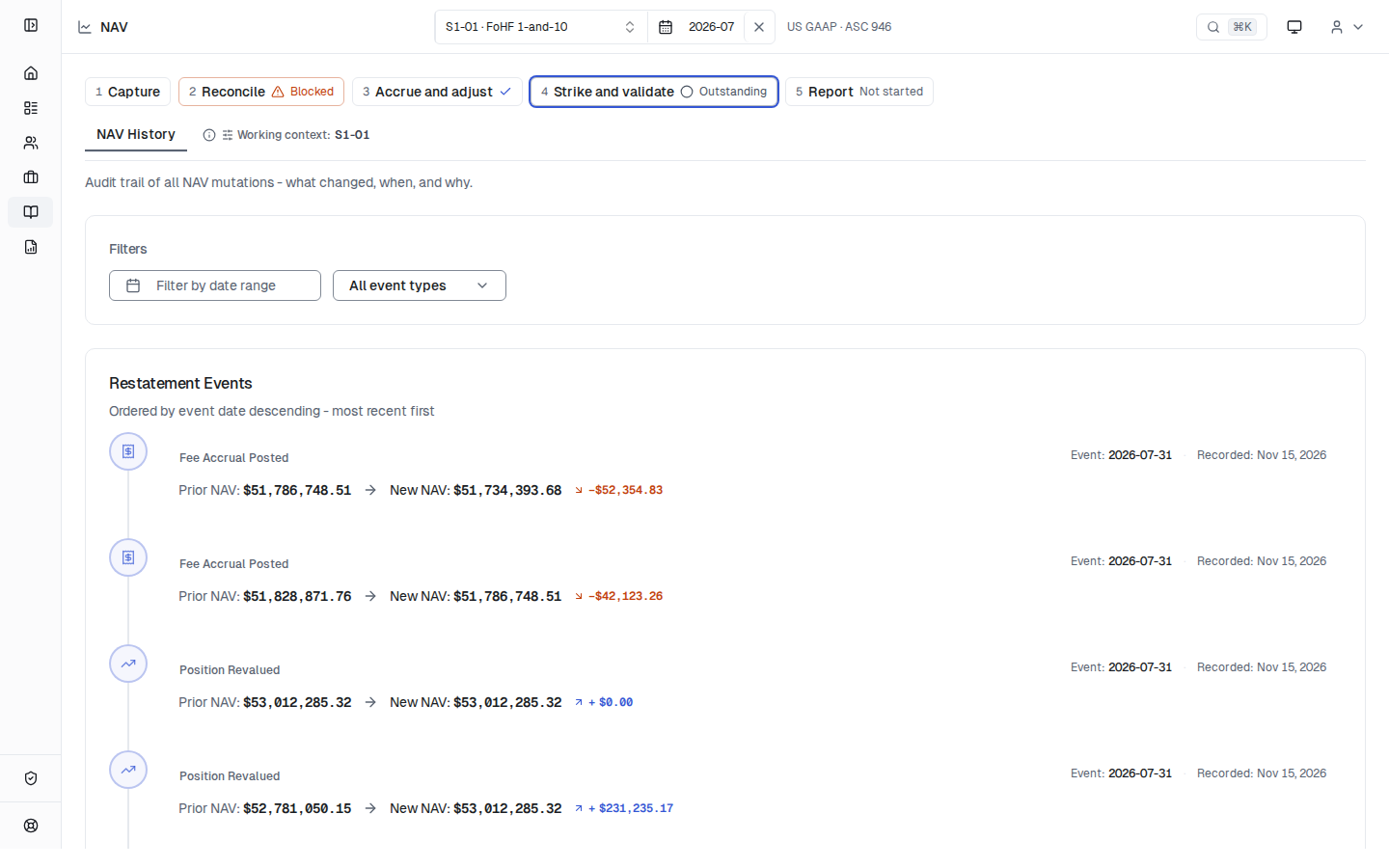
For unitized funds the Share register tab of NAV is the source of record for who holds how many units of which class and series. Series funds issue a new cohort at each dealing date; each cohort tracks its own basis and its own incentive against its own high-water mark until consolidation folds it into the lead series. The register and the capital account are two views of the same ledger, and they reconcile to each other by construction.