Securities and positions
Funds that trade instruments directly - equities, bonds, derivatives, digital assets - run on the security master: one shared reference for what an instrument is, so two funds holding the same bond agree on everything except how much of it they hold.
The instrument master
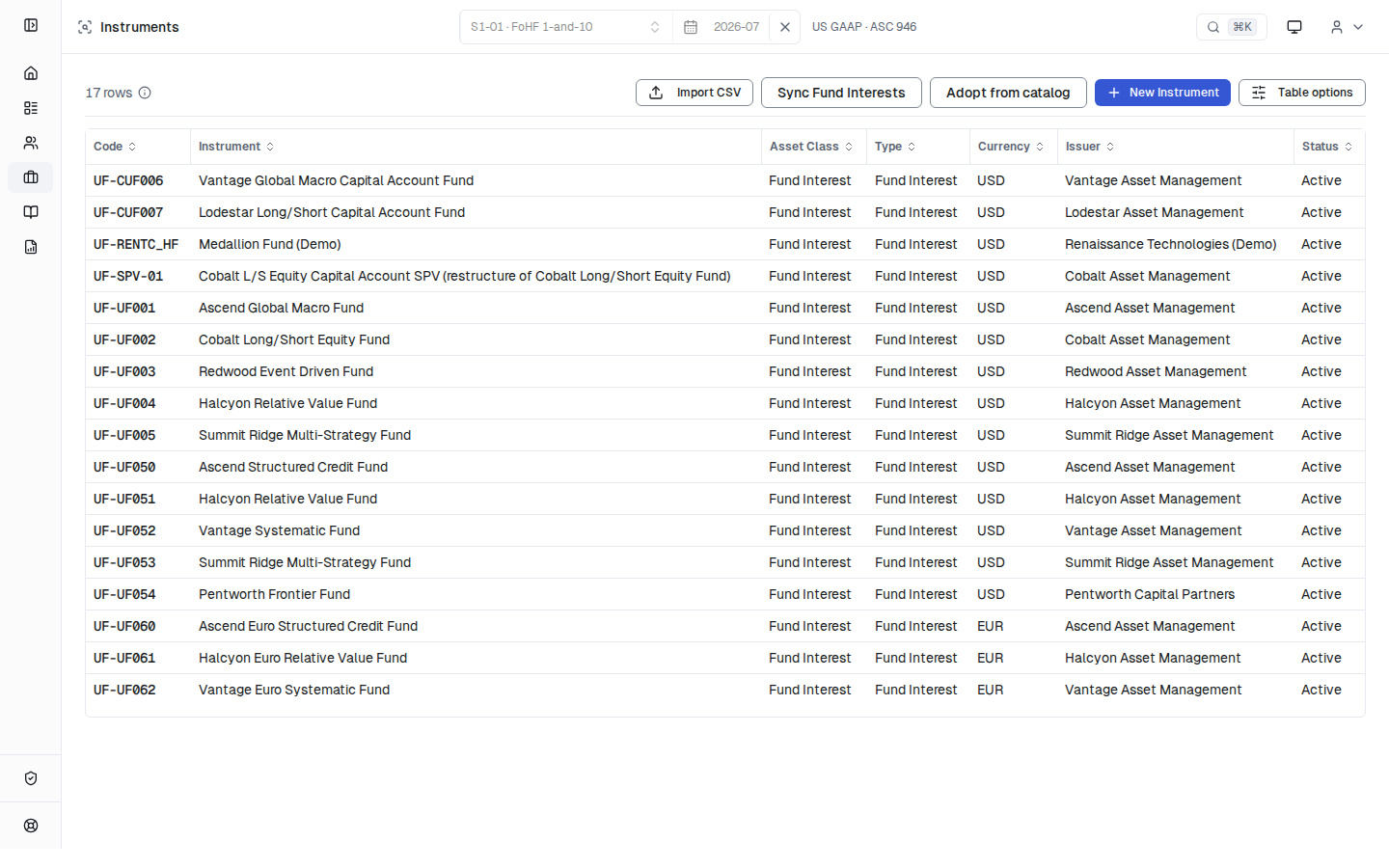
Instruments is the catalog: identifiers, classification, currency, and the class-specific terms that drive accounting - a bond's coupon and day count, a forward's legs, a loan's schedule. Instruments are reference data; positions in them belong to funds. Its first tab lists every instrument; the tabs beside it are the asset-class books described below.
Positions, trades, and lots
Holdings carries the positions and the activity that built them, one fund at a time. Its Securities tab lists each security position with its carrying value and accrued interest and runs the marks; its Unsettled Trades tab is the settlement queue; fund interests sit beside them under their own tab. Every position is backed by lots - each acquisition with its own date, quantity, and basis - which is what makes realized results exact rather than averaged, and what the transfer, redemption, and consolidation machinery operates on. Portfolio Transactions is the trade-level journal view: each buy, sell, and income event with the ledger entries it produced.
Prices and actions
The Prices tab of Valuations holds the marks: manually entered, imported, or pulled from index adapters. Revaluation reads the latest price as of the period and posts the unrealized movement. Corporate Actions processes the events that change positions without a trade - splits, dividends, mergers - each applied to the affected lots with its ledger effect posted, not adjusted by hand.
Class-specific books
Fixed income, derivatives, loans, other tangible assets, and digital assets each get their class-specific treatment on their own tab of Instruments - accrued interest and amortization for bonds, paired hedge accounting for forwards, custody tracked as location for digital assets on the same shared book. The class tabs specialize the presentation; the ledger treatment underneath is the same double-entry discipline as everything else.