Bringing data in
Onboarding a fund means moving its history and its reference data out of whatever it lived in before - spreadsheets, another platform's exports, a PDF of the LPA. The import machinery is built around one principle: the system may do the tedious part, but a human confirms everything before it becomes a ledger fact.
Structured imports
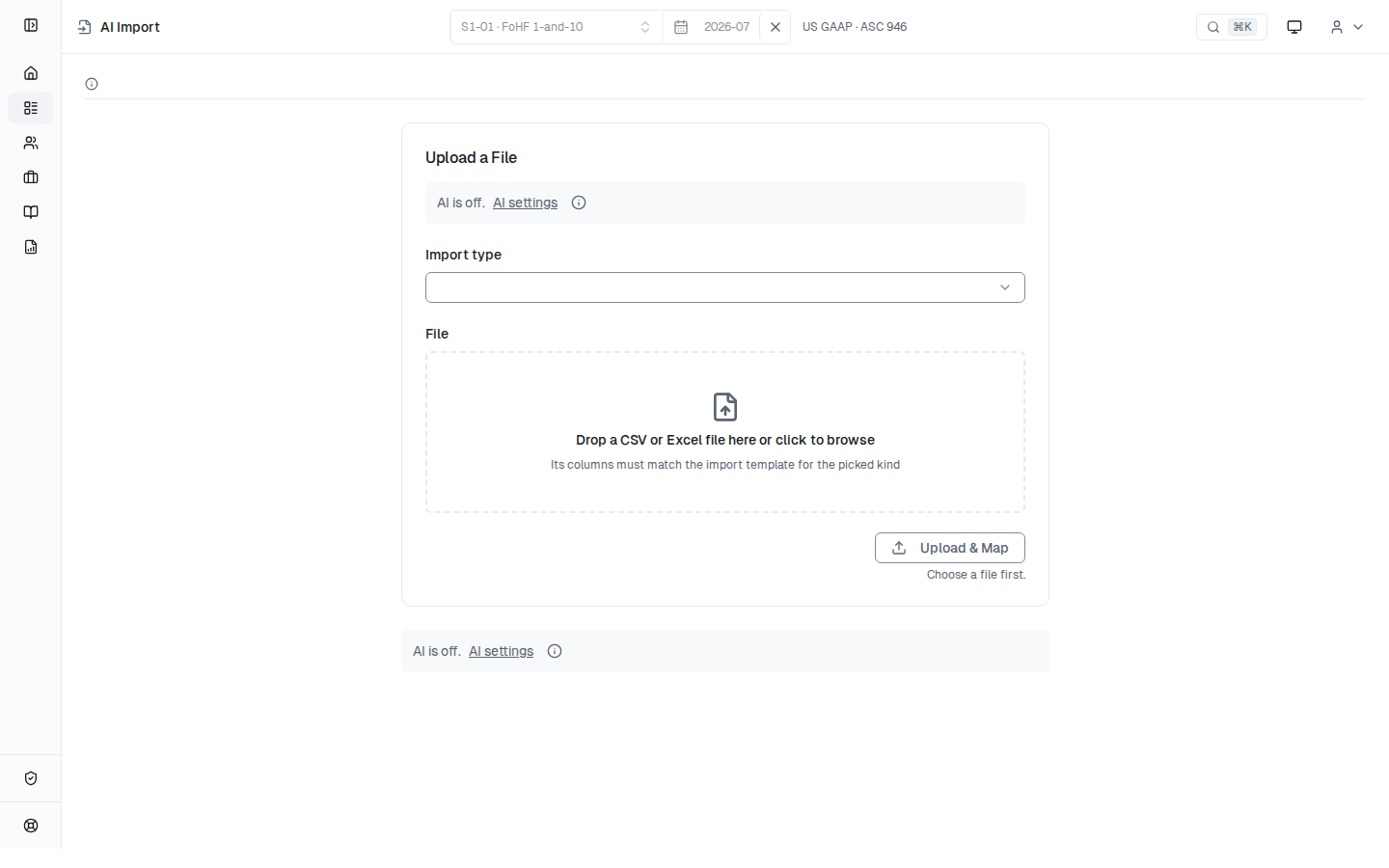
Settings › Onboarding accepts CSV files for each data kind - investors, capital activity, positions, prices, and the rest - with per-row validation and per-row results: what loaded, what was rejected, and why, row by row. Capital accounts are provisioned automatically as investor activity references them, so an import never fails for want of a container that the system can create itself.
Converting a fund: the handover's high-water marks
A fund converting from another administrator arrives with its fee state: one high-water mark per capital account. That mark must be the FLOW-ADJUSTED one - the last crystallized value carried forward through every subscription since (added in full) and every partial redemption since (scaled down pro rata) - because that is the mark the incentive engine clears. The last stored crystallization value is lower by every top-up since, and loaded as is it charges incentive on capital the investor merely contributed. When the pack is assembled, each mark is carried from its stated as-of date through the capital history, and a mark below that figure is a gap to acknowledge, with both figures and the difference. A mark the pack cannot check - a pooled series or class mark, a mark with no as-of date, a partial redemption stated only by amount - is listed as a warning rather than passed silently.
AI-assisted mapping
Real files are messy: columns named whatever the last administrator called them, dates in three formats, one sheet holding four things. The AI-assisted path takes the messy file and proposes a mapping into the platform's shapes, which lands as a STAGED REVIEW - every proposed row visible, individually acceptable or rejectable, with partial commit supported. The AI proposes; it never posts. What enters the books is exactly what a person approved, and the usage is logged.
Terms from documents
The same posture applies to fund terms: upload an LPA and the platform extracts the fee economics it finds - rates, hurdles, crystallization terms - and PREFILLS the fee terms form with them, citations attached. The human confirms in that form (onboarding's Fee terms card, or the fund's own Fee terms tab once it is live), where the extracted values are suggestions to inspect, not facts to trust. A misread clause dies in review instead of in an investor's allocation.
Integrations
Integrations is the tenant's half of the marketplace: browse what has been published, enable one with its credentials and a cadence, pause, resume or disable it, and see whether it is actually running.
The status column is the part worth knowing. It reports STALENESS, not the last result. A feed whose last run succeeded nine hours ago on an hourly cadence has stopped, and a grid showing "Completed" would call that healthy - so the verdict is computed from the cadence, when the feed was enabled, and whether the runtime answered at all. A feed that has quietly died reads as a deviation on this page instead of as a success nine hours stale.