Journal entries and the ledger
Everything in this platform ends in a journal entry. Subscriptions, marks, fees, allocations - each domain event posts through the same engine into one double-entry ledger, which is why the investor views and the financial statements cannot disagree: they are reading the same rows.
The entries themselves
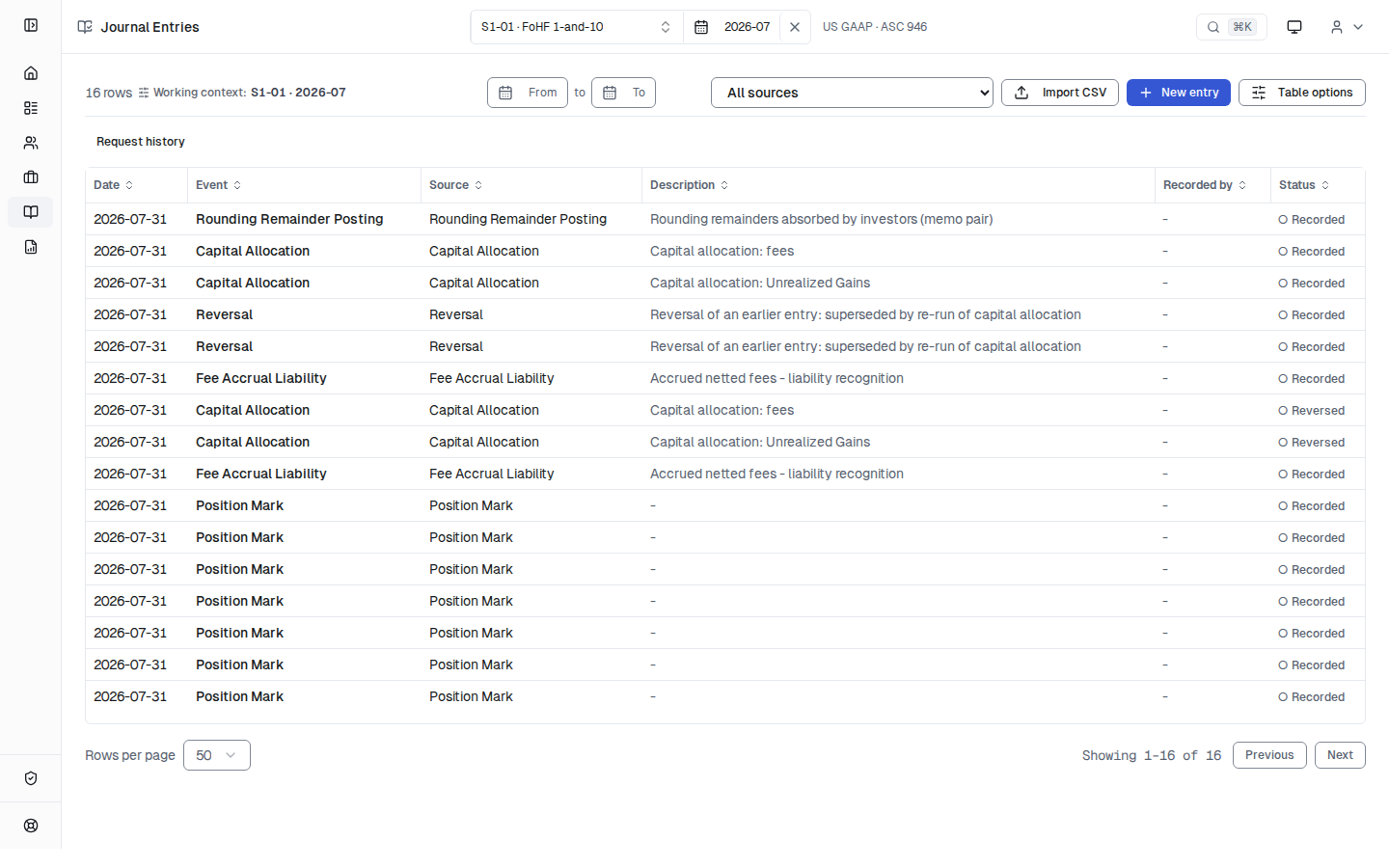
Journal Entries is the ledger's front door: every entry, its lines, its source (which domain event posted it), and its dimensions - fund, account, sleeve where sleeves are in use. Most entries are posted by engines; manual entries exist for the genuinely manual cases and go through the same create-review-post lifecycle, landing with their authorship in the audit trail like everything else.
Editability follows the period, not the entry: while a period is open, transactional entries can be corrected or removed with their postings unwinding cleanly; entries produced by period-level machinery (allocation results, close artifacts) are sealed regardless, because correcting those means re-running the machinery, not editing its output.
The accounts
Chart of Accounts holds the accounts - seeded from a standard template, extended per fund, and bound to the engines through account role mappings (see the setup chapter). The chart is the vocabulary; the mappings are what make the engines speak it.
Proving it balances
Trial Balance is the live proof: every account's debits and credits for the period, footing to zero. For an open period it recomputes from the ledger on every view. For a hard-closed period it reads the frozen artifact captured at close - the closing chapter covers why that distinction is what makes a sealed period worth something to an auditor.
From ledger to statements
The Reporting hub renders the income statement and the statement of changes in partners' capital directly from the ledger through the financials mapping. There is no separate reporting database to drift out of agreement; a number on the statements is a query over the same rows the trial balance foots.
Approval of manual entries
A workspace administrator can require a second person under Settings → Books → Posting setup → Approval. Leave the threshold blank for all manual entries, or enter a nonnegative amount. Approval applies when an entry's total debits strictly exceed that amount in its base currency; an entry at the threshold posts directly. Amendments use the replacement entry's total debits.
Entries requiring approval appear under Journal entries → Awaiting approval and stay outside the ledger. A different user with journal approval rights can review the lines, approve and post, or reject with a reason. The maker can withdraw their own pending request. Approval repeats the posting checks and records both people in the audit trail, while the posted entry retains its maker as author. Changing the policy leaves existing requests awaiting a decision.
System entries from capital activity, fees and trades keep their own controls. Journal CSV imports and AI-suggested postings remain blocked while manual approval is enabled; submit those entries individually for approval.