Capital calls and distributions
Closed-end funds run on promises: an LP commits capital, the GP calls it as deals need it, and value comes back through a waterfall that pays people in an order the LPA spent twenty pages defining. Each stage is a first-class object here, not a memo field on a wire.
Commitments and calls
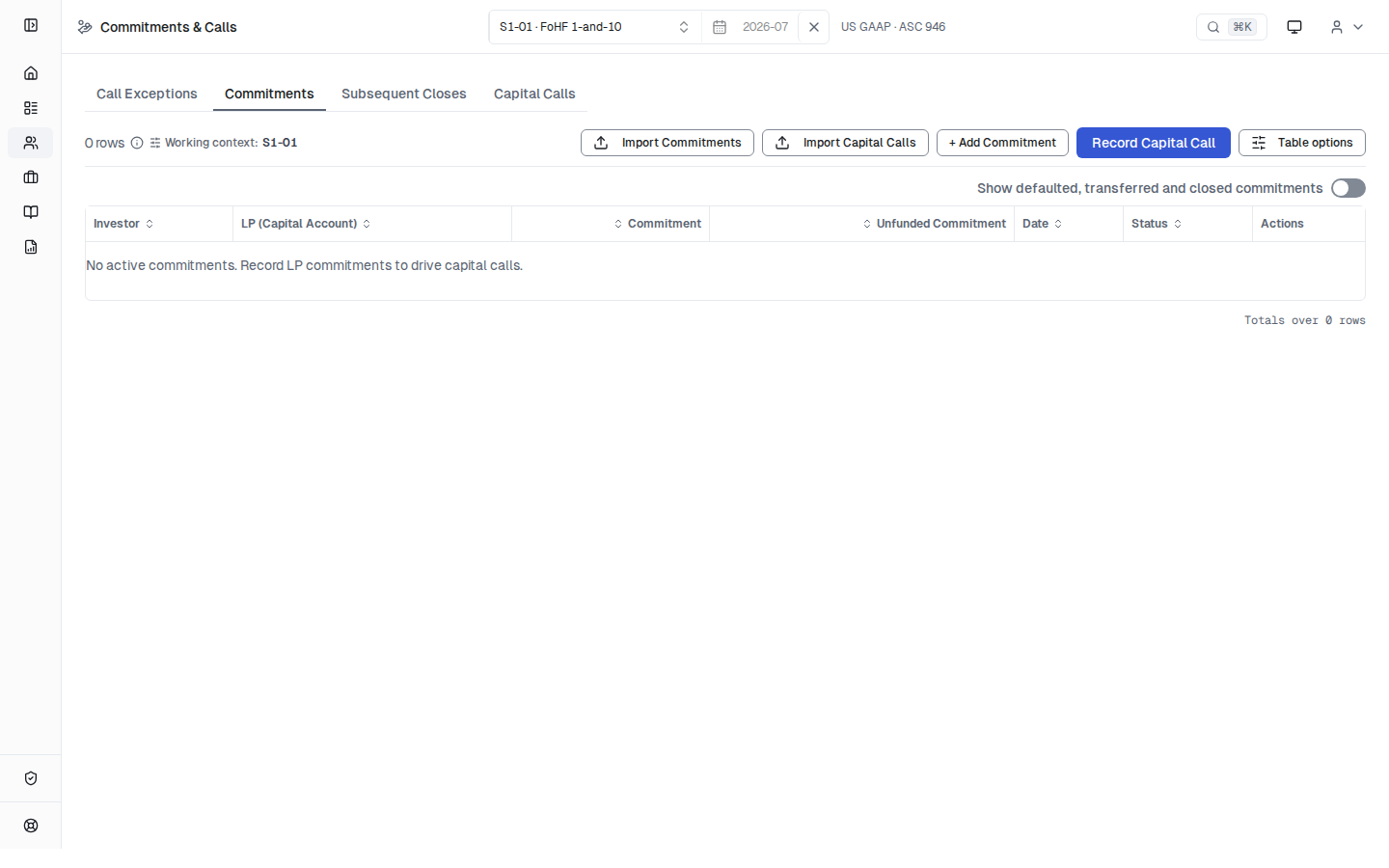
Commitments tracks each LP's commitment and its state: called, uncalled, recallable. A capital call is issued against commitments with its purpose broken into components - investments, fees, expenses - following the ILPA presentation LPs increasingly require, and the notice the LP receives renders from the same data the ledger books. Uncalled commitment moves when a call is issued, and unfunded commitment (the ILPA figure: committed less capital received, plus recallable distributions) moves when the money is received, not when someone updates a spreadsheet. Capital called but not yet received is shown on its own, as "Called, not received".
Record Commitment shows the LP's management fee terms before saving. It pre-fills the fund's Standard management fee with the source Fund standard terms; change the selection for this LP when appropriate. Existing LP terms and recorded side-letter overrides take precedence. New assignments start in the commitment's accounting period. Without standard terms, select management fee terms before recording the commitment.
Set or edit Standard on the fund's Fee terms tab. Confirmed LPA onboarding populates this default. AI Import's Also create commitments option shows and uses the same standard; missing terms are flagged on the review rows.
Investing feeder receipts in an evergreen master
On a funded call line, open settlement history and choose Invest in master. Select the feeder's existing investor account in the receiving evergreen fund and that master's dealing period. The investment portion of the cash receipt becomes units at the preceding struck NAV; fee and expense cash remains in the feeder. The same posting records the feeder's holding in the master.
The receipt, feeder and master must share a base currency. Retrying the same deployment returns its existing subscription. To correct it, reverse the master subscription before reversing the feeder receipt, then record a new receipt. Clear and reconcile the cash through the ordinary cash workflow.
Converting a drawdown basket into evergreen units
Choose New evergreen conversion on Continuation Vehicles with the source drawdown fund selected. Name an existing evergreen and its receiving share class, enter the agreed price of every source holding, the closing date, election deadline and percentage of GP carry to roll. Close on the first day of a target accounting period whose preceding NAV is struck.
Review the source waterfall's split and each LP's cash or roll election. LPs
default to cash. Import elections CSV accepts account_code,election with
optional carry_unfunded; use ROLL or SELL and true or false. Enter the
date the elections were received. The whole file must validate before any
election changes.
Closing transfers the identified assets, settles source carry and issues target units for net LP proceeds and any rolled GP carry. It does not use the target's redemption gate. The target needs existing operating cash for sellers and carry paid in cash. Source unfunded releases unless an LP explicitly elects to carry it into a commitment-enabled target.
The supported basket uses base-currency underlying holdings and commitments; source and target share a base currency. The target is unitized without series accounting and must not already hold the same assets in an active position. Reverse the conversion as a whole to unwind its assets, carry and units and restore source commitments. Later allocations or transactions must be undone before the conversion can reverse.
Distributions and the waterfall
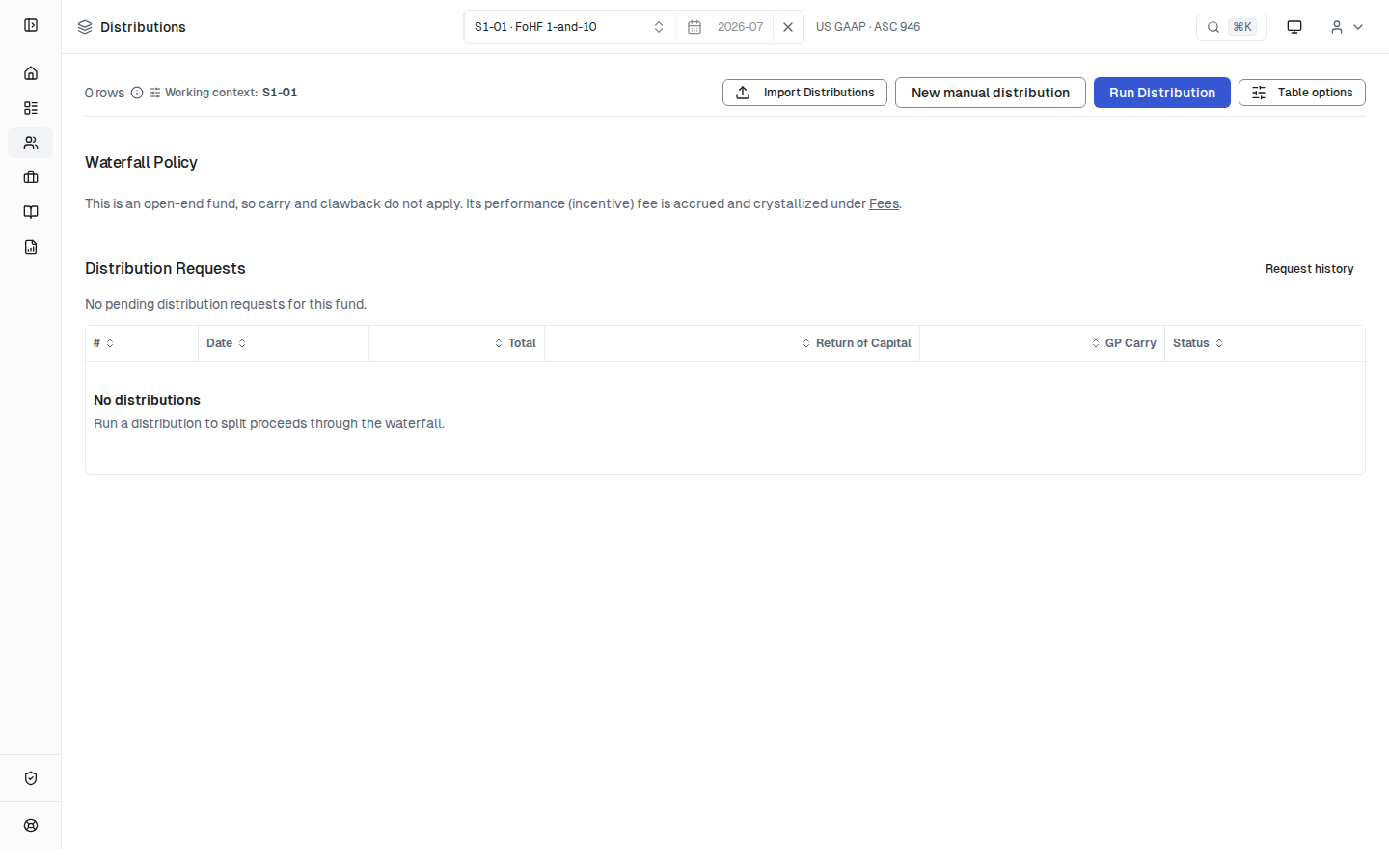
Distributions returns value, and the Waterfalls configuration decides who gets it in what order: return of capital, preferred return, GP catch-up, carried interest - arranged European (fund-level) or American (deal-by-deal) with the LPA's tier structure expressed as configuration rather than code. A distribution run computes each LP's share and the GP's carry, books both, and can mark components recallable where the terms permit recycling.
When carry comes back
Deal-by-deal carry paid early can exceed what the whole fund's outcome justifies. LP Givebacks and the clawback machinery track the GP's contingent obligation and the LP-side equivalents, so the fund's final settlement is a computed number with a history, not a negotiation. The platform carries these balances from the first distribution onward - the end of a fund's life is exactly the wrong time to start reconstructing them.