Currency and market data
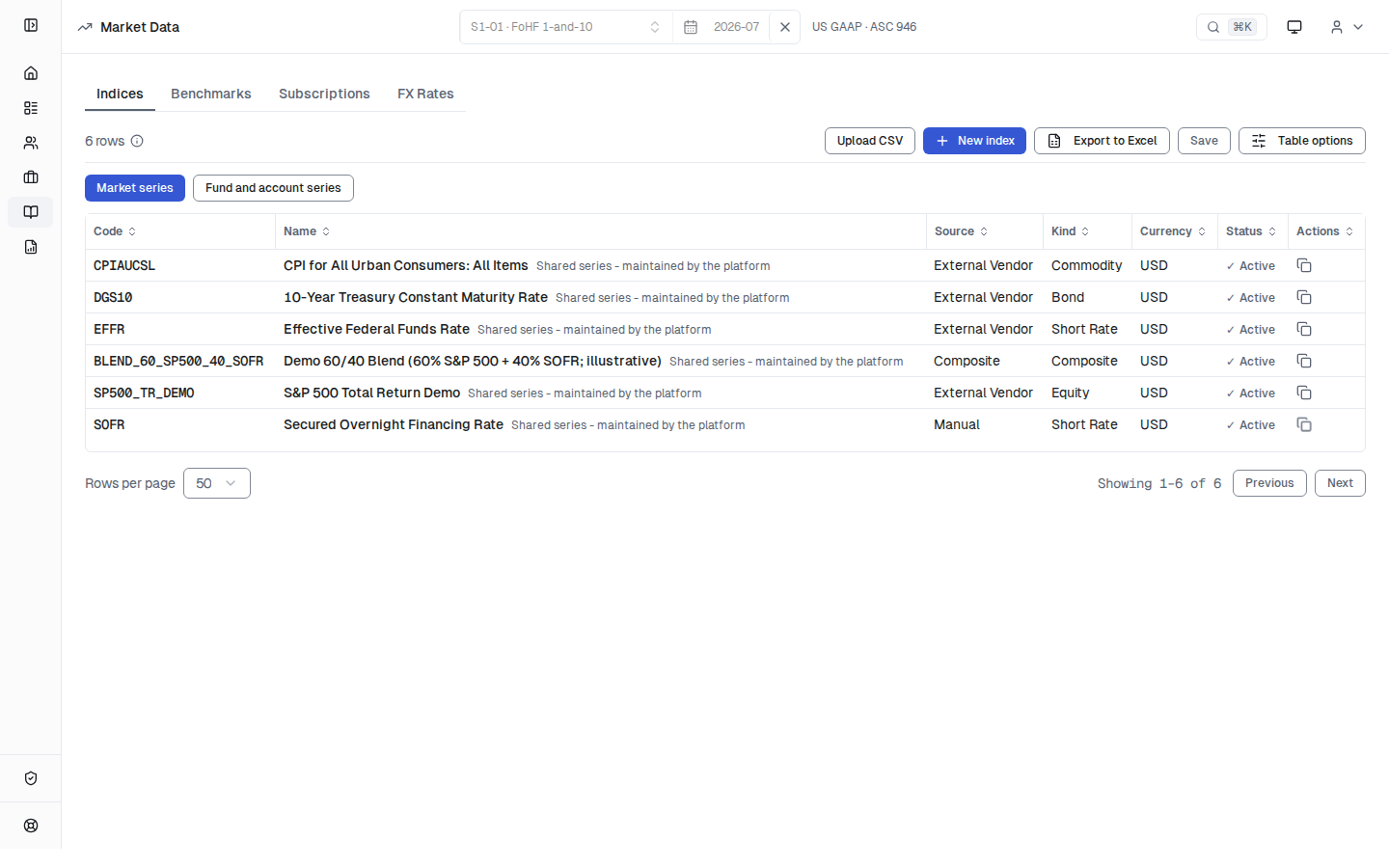
Multicurrency funds live or die on two reference feeds: exchange rates and index observations. Both follow the same discipline as every other input here - ingested with provenance, applied by engines, never typed into a result. They live on one page, Market data, as three tabs: Indices, Benchmarks and FX rates.
FX rates
The FX rates tab holds the rate book: currency pairs by date, loaded from files or entered with an audit trail. Everything currency-related reads from here - translating a EUR expense into a USD fund's base, marking a hedge, and the denominated-class machinery that lets an investor subscribe, report, and carry a high-water mark in their class currency while the fund's book stays in base. Amounts are stored with both local and base values and the rate that linked them, so a translated number can always show its work.
Indices
The Indices tab manages benchmark series - market indices and reference rates, pulled through adapters or loaded directly - used for hurdle rates tied to a reference index and for performance comparison. Observations carry their source and ingestion run, so a hurdle computed off an index value can be traced to the exact observation that fed it.
Benchmarks
The Benchmarks tab holds this tenant's custom and blended benchmarks. A benchmark here is a first-class derived index, not a display setting: its identifier is what a fee structure, a household or an attribution comparison stores, so this is a list of SERIES that other things point at.
Opening a row opens the builder, where the composition, the version history and a live preview sit together - a blended benchmark whose weights changed last quarter has to be able to say when, or the comparison it feeds cannot be reproduced.