Closing a period
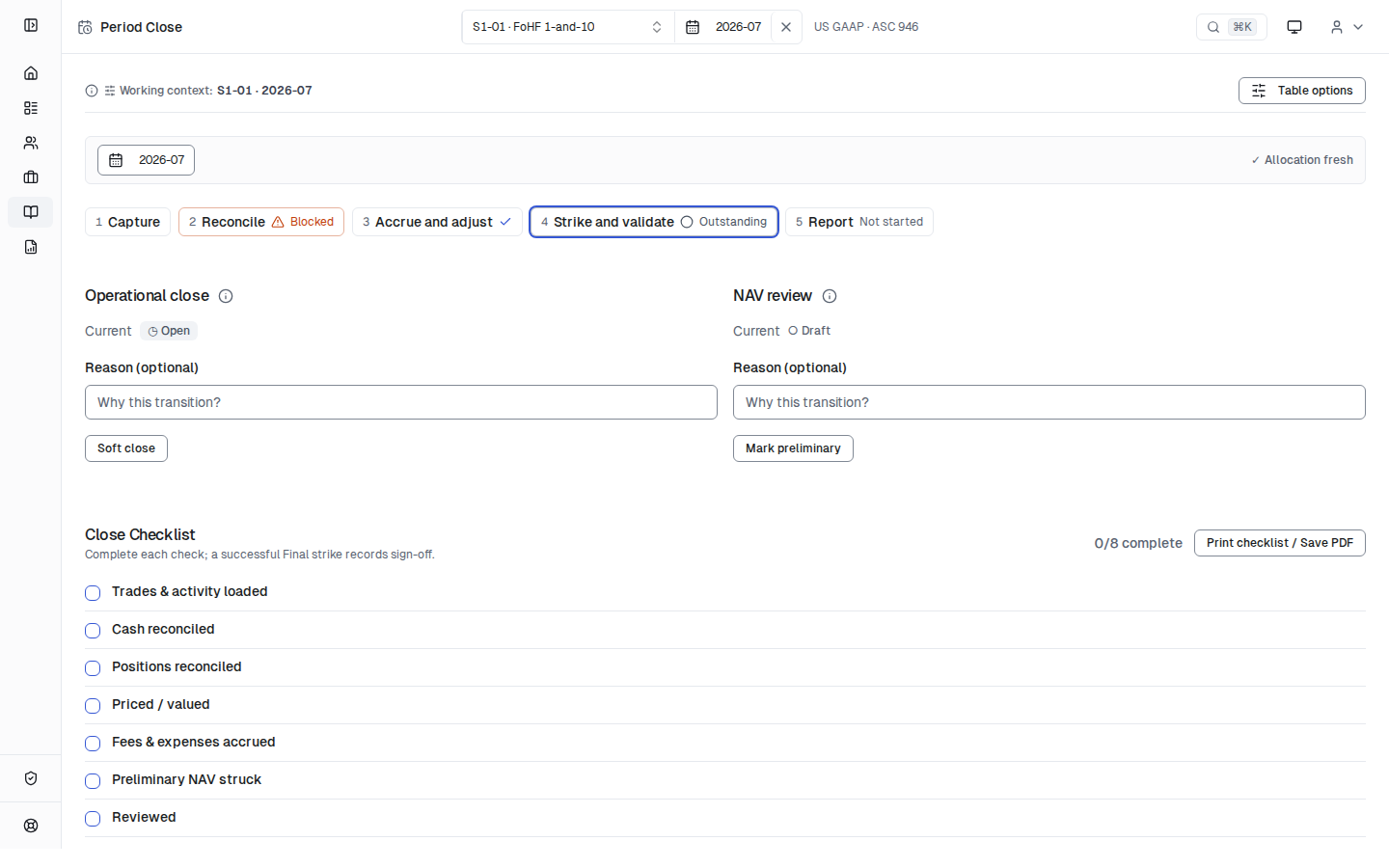
Closing is a promise: what this period reported is what it will always report. 1494 Labs separates the promise into two axes on Period Close: review (draft, preliminary, in review, final) tracks sign-off on the numbers, and close (open, soft closed, hard closed) tracks whether the period accepts writes.
The walk
A period walks open, then soft closed, then hard closed. Soft close is reversible; a soft-closed period can be reopened for corrections. Hard close is final by design. There is no reopen from hard closed: corrections to a hard-closed period are recognized in the current open period instead, with an audit trail linking them back. The finality is deliberate. A sealed period that can quietly change is worth nothing to an auditor.
What the close guards check
The close refuses when the period's state is not actually finished:
- Unreflected fee accruals. Fee events that post late in the allocation sequence (an incentive true-up at year end, for example) require one more allocation run so the active run reflects them. The guard names the amount it cannot see reflected; the fix is to re-run the period's allocation, not to force the close.
- Pending crystallization events. An incentive event stuck pending means the fee lifecycle for the period never finished.
- Negative capital. A close that would seal an account below zero is refused with the account named.
The frozen trial balance
Hard-closing captures a frozen trial balance: the period's ledger, as reported, stored as an artifact. Closed-period statements read the artifact rather than recomputing, so a later correction cannot silently rewrite history. Trial Balance shows the live ledger; for a closed period the frozen revision is the authoritative version, and any deliberate revision to it is graded and audit-logged.
After the close
Strike the final NAV on NAV History if it has not been struck, and leave the current year open: a book whose every period is sealed cannot demonstrate any of the work an administrator actually does.