Cash and reconciliation
The ledger records what should happen; cash records what did. This platform keeps the two honest against each other continuously, not at month end: every posting that touches a cash role derives a movement in the cash sub-ledger at the moment it posts, and the reconciliation machinery lives on the difference between expectation and settlement.
Clearing
Cash is a transactional clearing surface. A posted subscription creates an expected receipt; a redemption an expected payment. Settlement can arrive whole, partial, or in pieces with a holdback - each settlement is matched against its expectation, and the residual stays visibly open rather than dissolving into a balance. The liquidity view aggregates what is expected in and out, which is what a controller actually wants to know before approving a payment.
You can also record subscription receipts directly on Subscriptions & Redemptions or the subscription detail, using Record cash received. The detail shows the receipt history and offers Reverse receipt with a required reason. A posted redemption's detail offers Record cash paid. These actions use the same cash permissions, journal entries, partial settlement and period guards as Cash.
Negative available cash is not forbidden - an accounting platform shadows reality rather than blocking it like an order system. Liquidity constraints are informational by default and become hard enforcement only where a fund opts in.
The engine-mode and SOR-mode legs
Manual Cashflows shows LP cashflows in both lives they can lead: computed by the engine from the fund's terms, or recorded from an external system of record. Both settle on one ledger; the page is where a mismatch between "what the terms say" and "what was wired" becomes visible instead of buried.
The bank statement
The Bank tab of Reconciliation is the external side of cash: import a statement against a cash account and the lines are matched to the cash sub-ledger automatically. The matcher only takes EXACT-UNIQUE hits - one line, one candidate, one amount. Anything ambiguous is left for a person rather than resolved on a best guess, because a wrong auto-match is harder to find later than an unmatched line is now.
Every statement raises two exceptions by construction: the bank-versus-book balance, and whatever activity did not match in either direction. Both land in the ordinary worklist below, which is where they get worked: each opens from its statement straight into the worklist, filtered to that one exception.
Exceptions
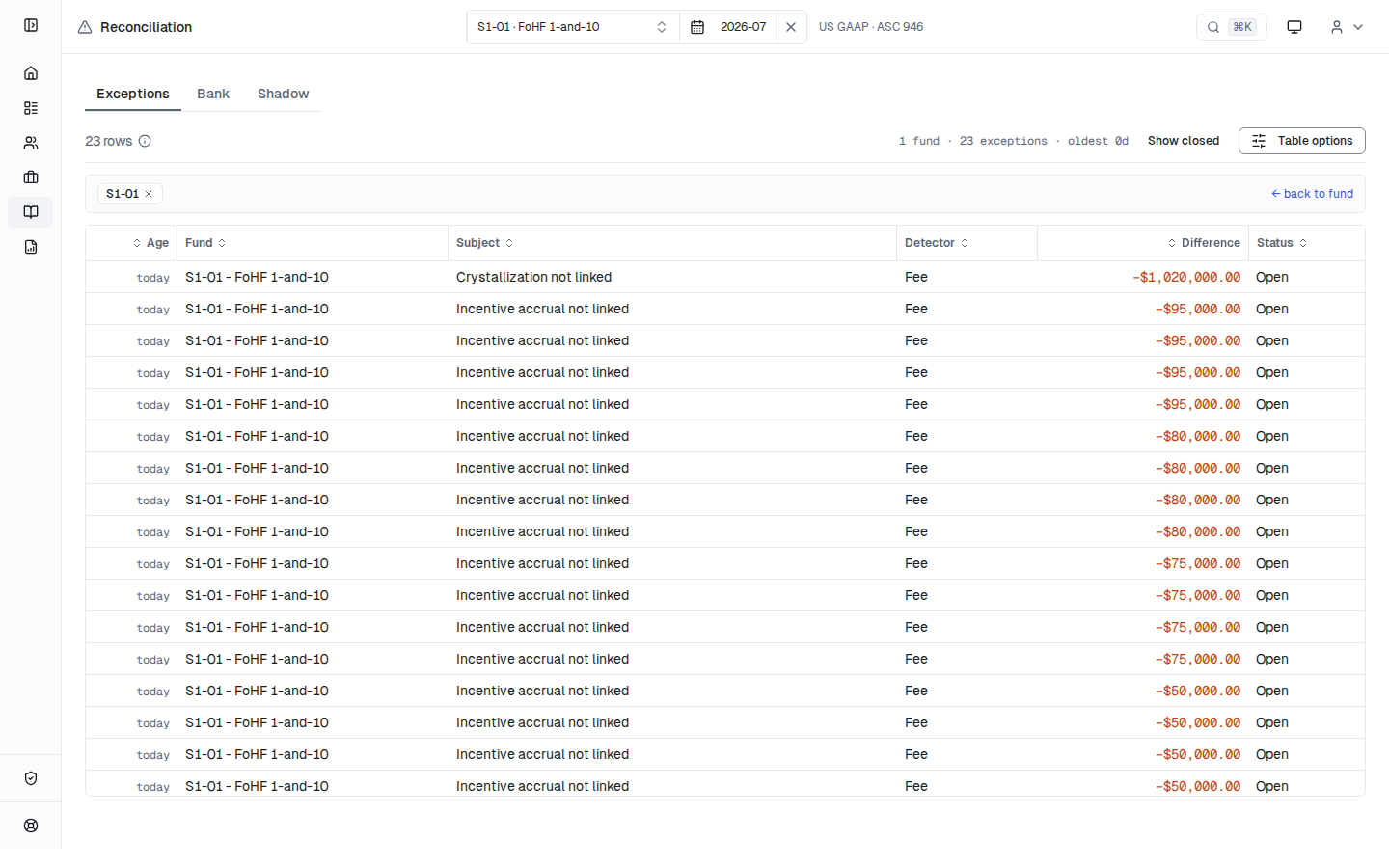
The Exceptions tab of the same page is the reconciliation worklist: every detector-raised difference between the sub-ledger and the ledger, between expectation and settlement, between two views that must agree. An exception carries its stage, its age, and its resolution trail. The administrator's loop is the point: work the list to zero, and anything that reappears has a cause worth finding. A clean worklist is the operational meaning of "reconciled."
Settled and pending balances
Pending balances include only cash that is not already included in settled balances. For the same date and currency, add settled and pending to see projected cash after the remaining pending flows. This applies to cash accounts, sleeves, firm-wide balances, saved table calculations, and their Excel exports.
A cash-paid expense is included in settled cash when posted. Its payment may still await confirmation in the movement worklist, but it contributes zero to the pending balance. Confirming that payment does not deduct the expense again. An unpaid obligation that has not reached cash remains in pending until paid.
Home cash cards show their stated GL cash balance. The Home and fund cash projections also exclude pending amounts already booked in their starting cash balance, so payment confirmation does not forecast the same outflow again.