The asset side
The investor side of the book asks who owns the fund; the asset side asks what the fund owns. For a fund of funds that means positions in underlying managers' funds, and everything downstream - marks, exposure, fee transparency - flows from keeping those positions honest.
Positions and marks
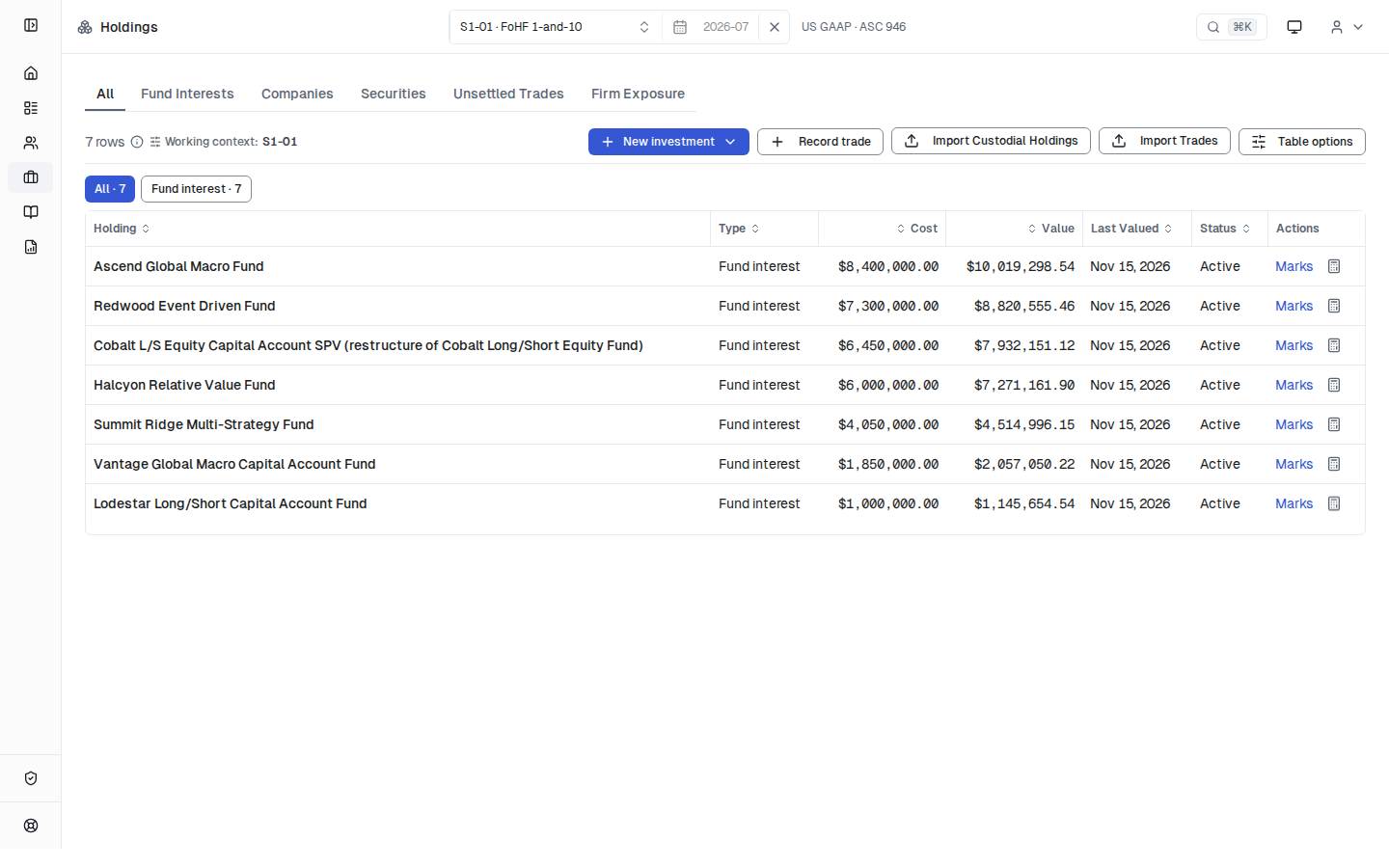
Holdings lists the fund's positions in underlying funds: cost basis, current value, unrealized result, each backed by lots the ledger can account for. Directly held securities and their settlement queue are further tabs on the same page, and its Firm Exposure tab shows the same fund interests across every fund at once, by manager and underlying fund. Where funds report in different base currencies that tab states no cross-currency total until a reporting currency is chosen, and then names the spot-rate date it translated at. Valuations is where marks land - a manager's reported NAV revalues the position, and the revaluation posts to the ledger the moment it is applied. Statements can arrive as estimates and be trued up when finals come; a true-up after the period sealed is recognized seal-safely, with the catch-up recorded rather than history rewritten.
Who the managers are
Fund Investments (the Underlying Funds page) has three tabs. Performance opens first: for the working fund, a summary strip and a table of every private fund it has a commitment to, with commitment, paid-in, distributed, NAV, DPI, TVPI and IRR and a Total row that equals the strip (index funds and hedge funds are left out). Funds and Managers are the reference layer: the firms and vehicles behind the positions, with the transparency profile a fund of funds diligence process expects - what the manager discloses, how stale their last report is (staleness is always a number here, never "unknown"), and the terms the fund invested on.
Seeing through
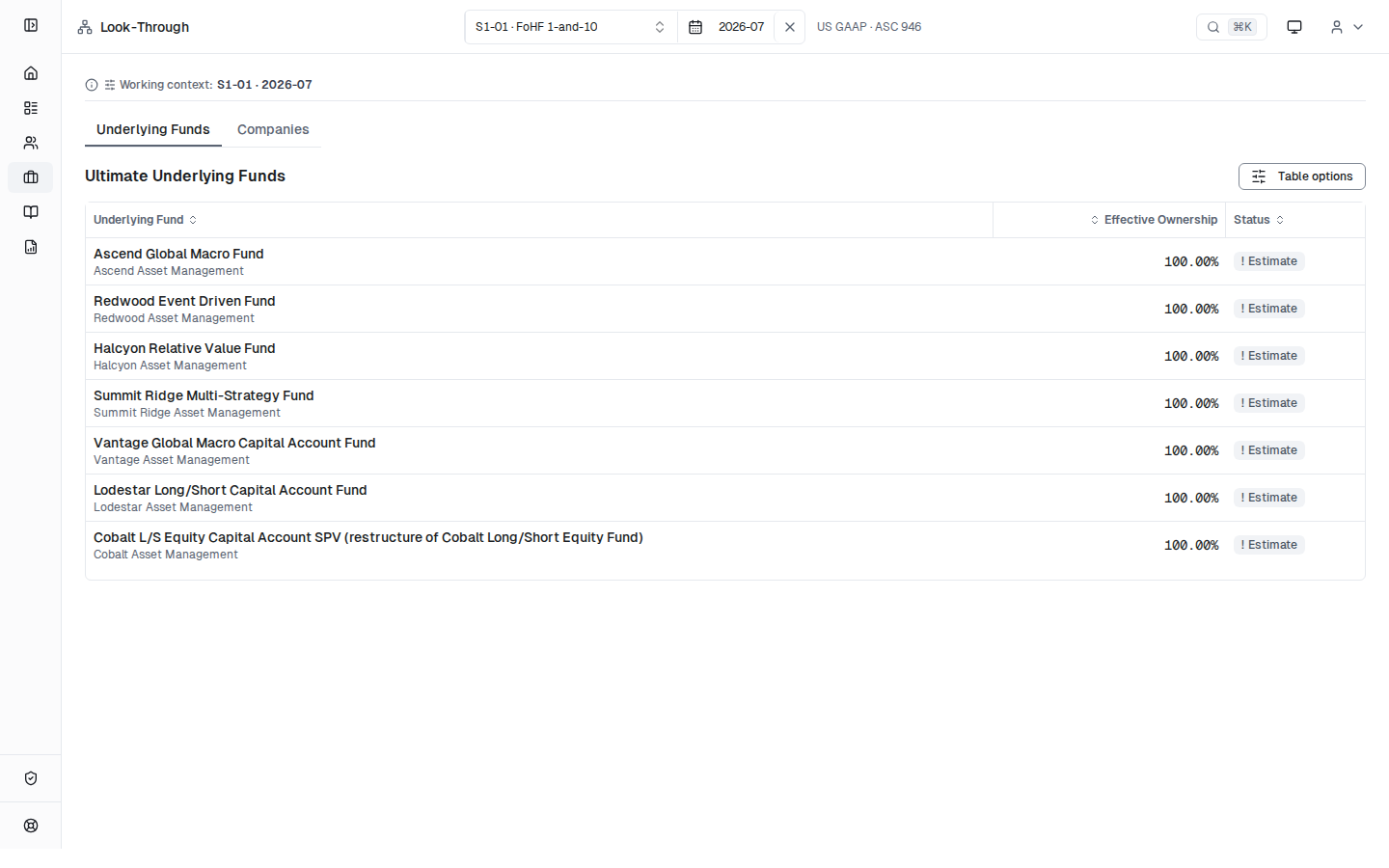
Look-Through answers the question one level down: what does the fund hold, through its managers? Exposure is value-weighted from the most recent underlying disclosures, and the fee stack's second layer (the fees embedded in underlying funds) is captured as disclosure - reported in the total expense ratio and look-through views, deliberately never booked to the ledger, because the manager's NAV already nets those fees and booking them again would double-count.
What kind of asset
Asset classification holds the configurable what-KIND-of-asset trees. A tenant can hold several named taxonomies - a hand-built one alongside installed open standards such as NAICS, SIC or NACE - and choose which applies per fund; a fund that never chooses uses the tenant Default, which is one taxonomy in the list like any other. Schemes whose licensing restricts reproduction are deliberately not offered.
Opening a taxonomy gives one page with four tabs. Tree is the tree itself - family, then group, then strategy, to the depth that taxonomy allows - with presentation order held as data rather than sorted alphabetically and hoped for. Assignments points each underlying fund and instrument at a node, one at a time, by a previewed rule or from pasted codes. Coverage names what is still unclassified, and History keeps every change.
A sleeve says whose money; a classification says what kind. The two are never conflated. Deleting a node something still uses is refused by the server rather than cascaded, because the alternative is holdings silently dropping into Unclassified and a report that looks complete.
Attribution
Allocation Analysis asks which asset class drove the quarter. For each node of the classification tree it reports the beginning and ending weight against the top of the tree, the period return, and the contribution to return - the decomposition, not a single headline.
Performance is not one number, so the axes are explicit controls on the toolbar rather than assumptions buried in the query. Two of them - look-through, and gross of fees - are visible but DISABLED, because they are not computed yet. A disabled control declares a limit; a control that silently returned the net figure under a "gross" label would not.